


You may also like
-

Celestial planisphere Poster
Joseph Forest · 1945 · A scientific print maps twin teal hemispheres and densely labeled constellations against warm beige
Poster from €9 · Framed from €16
-

Planet System Poster
Institute of Liepzig · 1988 · Vintage solar system chart poster with green and beige tones and detailed orbits
Poster from €9 · Framed from €16
-

Transparent Solar System Poster
James Reynolds · 1851 · Detailed solar system scientific print with labeled orbits and hand-tinted planetary accents
Poster from €9 · Framed from €16
-

General plan of the planetary system Poster
Lucien Rudaux · 1923 · Scientific print mapping planetary orbits around the Sun in a deep blue astronomical chart
Poster from €9 · Framed from €16


-

"Very nice Posters. The quality is amazing and we received it very quickly !"
-

"A shop to visit absolutely. Huge selection of posters. We spent more than an hour there !"
-

"Perfect to find gift. Price are very good. An they can frame and pack it on site"
About the Artist
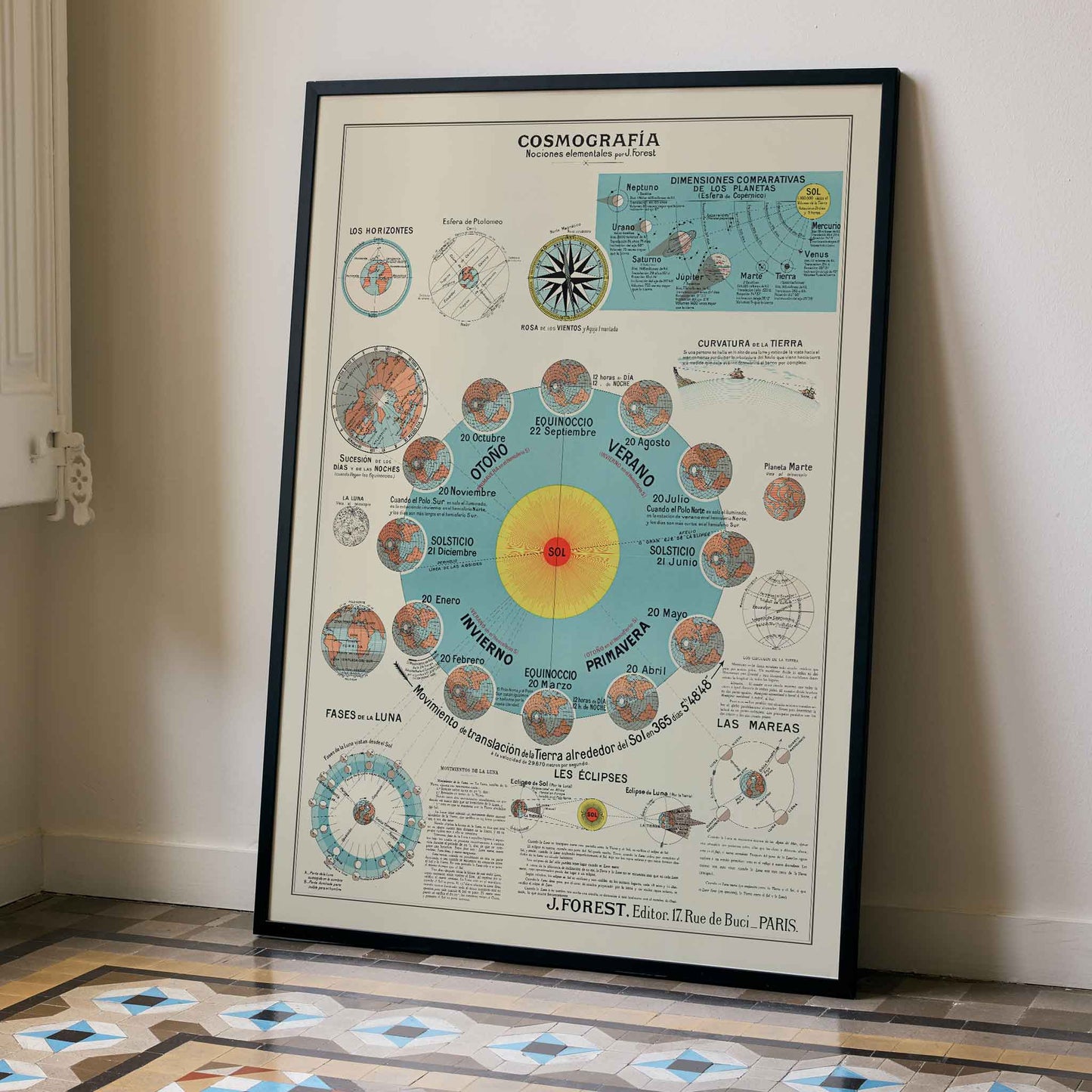
Joseph Forest is named at the foot of this 1929 cosmography chart, where J. Forest appears as editor at 17 Rue de Buci in Paris. The credit anchors the sheet to a specific publishing address rather than an anonymous origin. From that base, the subject becomes practical: a printed guide to the yearly path of Earth, the phases of the Moon, and the tides. Forest name therefore connects the image to both a person and a publication address, giving this vintage poster a traceable place in the history of popular science. Its educational purpose is clear in the labeled diagrams, which invite readers to follow celestial cycles without specialist equipment.
The Artwork
Elementary Cosmography turns the broad subject of the sky into a single reference sheet. Its purpose is not to narrate a myth or celebrate a discovery, but to make recurring celestial relationships available for study, from the solar year to the phases of the Moon. Dated 1929, the vintage print belongs to a period when printed science could travel beyond observatories and specialist books. A reader could return to the chart to connect a date with a seasonal position or to understand how the Moon relates to tides. That practical invitation gives the work historical force as educational wall art and a fine art print.
Style & Characteristics
The eye is drawn first to the yellow Sun at the center, then follows the ring of seasonal dates around it. Each stage of the year is paired with a small globe and a labeled position, so the circular route reads almost like a clock. Above, separate diagrams explain lunar phases and comparative planetary dimensions, while the lower band gives the Moon and tides their own studies. Beige paper carries the ink, with black lettering and outlines containing blue-green fields and touches of red. Spanish labels, fine rules, and miniature diagrams create the exacting character of this vintage scientific print, while the saturated center keeps the subject vivid.
In Interior Design
Picture the vertical poster in a quiet study above a walnut writing desk, where morning light can reveal its fine labels. A slim black frame echoes the printed border, while the warm beige field softens the geometry of the surrounding furniture. Seen from the doorway, the central solar wheel reads as a radiant emblem; up close, the smaller diagrams invite deliberate study. The tall format gives the wall a clear point of orientation without overwhelming the room. As framed wall art, this historical science chart brings a sense of inquiry to home decor and gives interior decoration a distinctly astronomical focus.